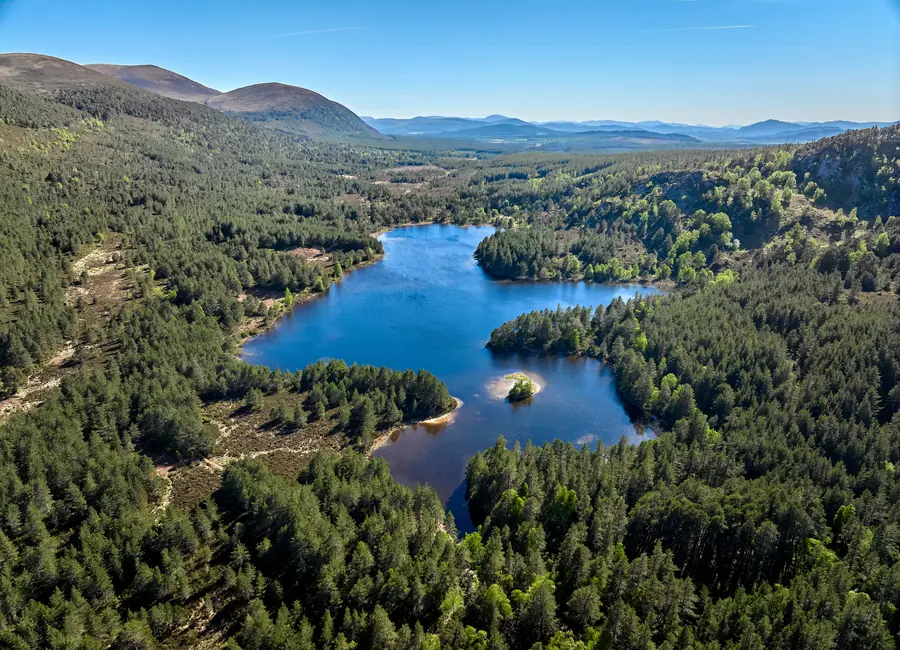
The Cairngorms National Park was established in 2003 — the second of the two parks created by the Scottish Parliament, after Loch Lomond and the Trossachs — and after an expansion into Perth and Kinross in 2010 it is the largest national park in the United Kingdom, covering around 4,500 square kilometres.
Aviemore sits on its north-western edge and is the main gateway, which is why a town of three thousand people has a railway station, a ski area and a visitor economy on this scale.
The Cairngorm plateau — the largest continuous area of high ground in Britain, holding five of the six highest mountains in the country and an arctic-alpine environment that exists nowhere else on the island. Snow lies in the corries into summer, the wind speeds recorded on the summits are among the highest in the world, and the plant and animal communities are subarctic rather than temperate.
The Caledonian pinewood — Rothiemurchus, Glenmore and Abernethy together hold the largest surviving fragments of the forest that once covered much of the Highlands. Open-grown Scots pine, juniper and blaeberry, with dead wood left standing; it looks nothing like a plantation.
The straths and rivers — the Spey, one of the great salmon rivers, and the farmland and settlement of the valley floor.
The park’s list is the reason British naturalists come here.
Capercaillie, the giant forest grouse, now clinging on in a handful of Scottish forests. Scottish crossbill, Britain’s only endemic bird species, found nowhere else on earth. Crested tit, restricted in the UK to these pinewoods. Ptarmigan, dotterel and snow bunting on the high tops. Golden eagles and, in summer, ospreys on the lochs.
On the ground: red squirrels, common here and easy to see; pine martens; mountain hares; red deer in very large numbers; and wildcats, functionally lost in the wild but part of a serious captive breeding programme at the Highland Wildlife Park.
Plus Britain’s only free-ranging reindeer herd, on the Cairngorm slopes above Glenmore.
The pinewoods first, because they are on the doorstep and they are what makes this park different: Loch an Eilein, Glenmore, the Ryvoan Pass and Abernethy are all within fifteen kilometres and all easy walking.
The plateau by funicular for the view, or on foot from Coire Cas for the real thing — with the caveat that it is severe ground.
The straths south to Kingussie, Newtonmore and Ruthven Barracks, and north-east to Boat of Garten, Nethy Bridge and Grantown.
Dark skies: the park has very little light pollution and is one of the better accessible stargazing areas in Britain.
Scottish access rights apply: a right of responsible access over almost all land and inland water, which is why a week here can cost so little.
The weather is the constraint. Spring comes late — snow lies on the tops into May — and the plateau makes its own conditions. Check a mountain forecast rather than a valley one.
Midges from June to September in still weather near water and in the woods.
Ticks in bracken and long grass from spring to autumn.
It is a working landscape as well as a park: estates, farms, forestry and sporting interests. Leave gates as you find them and keep dogs under close control near stock and ground-nesting birds.
Around 4,500 square kilometres, making it the largest national park in the United Kingdom.
In 2003, and expanded into Perth and Kinross in 2010.
The arctic plateau habitat, the largest surviving Caledonian pinewoods, and species including Scottish crossbill, crested tit and capercaillie.
Yes. Scotland’s access legislation gives a right of responsible access over almost all of it; only car parks and attractions charge.
Loch an Eilein or Glenmore for the pinewoods, and the funicular or Coire Cas for the mountains.