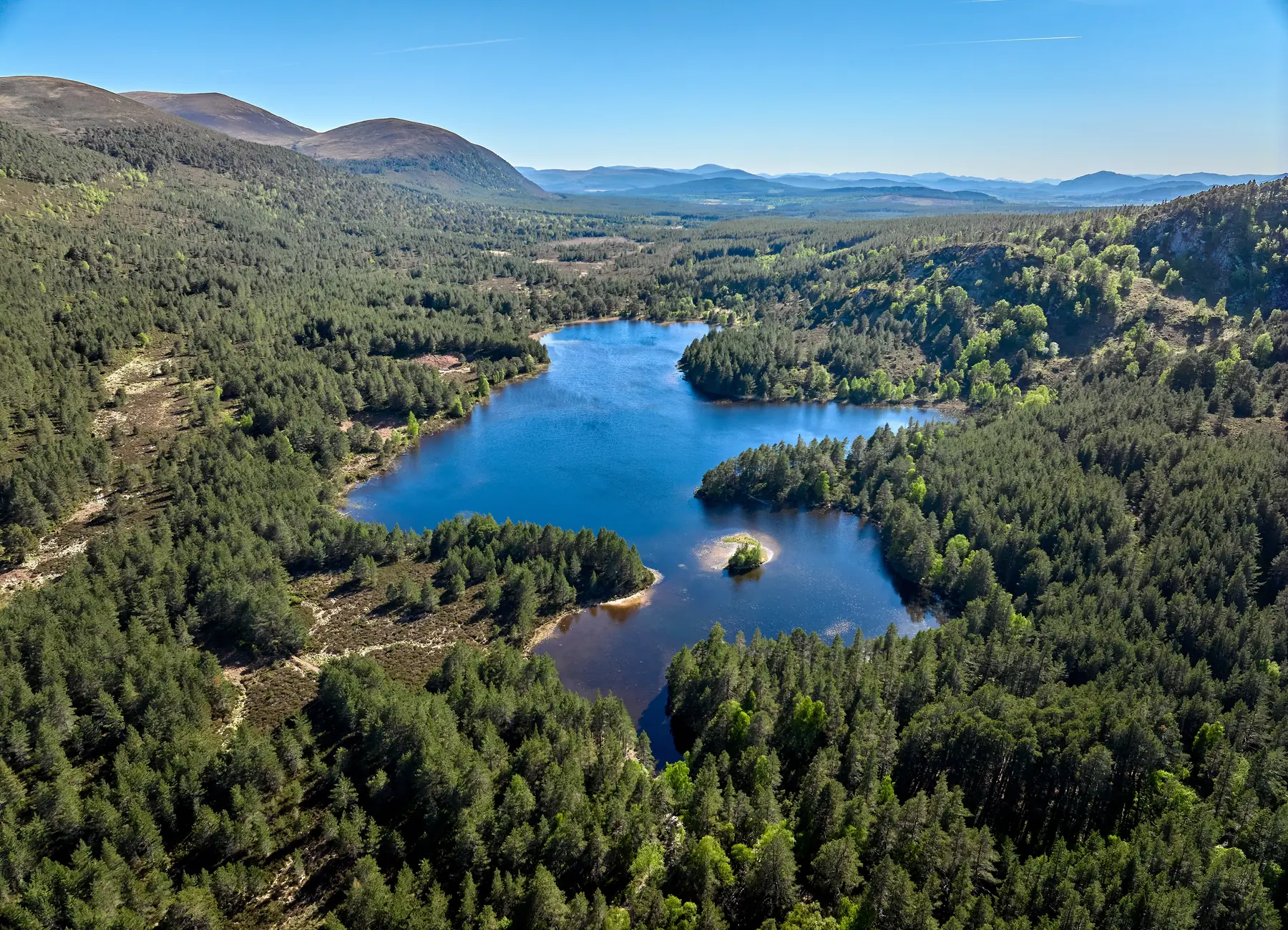
Aviemore has a reputation as an expensive place, and for the paid attractions that is fair enough — the adventure parks, the wildlife park and the mountain railway all charge properly. But the Cairngorms themselves are free, and they are the reason to come. The largest area of arctic plateau in Britain, the biggest surviving fragments of the Caledonian pine forest, a sandy beach at 300 metres and one of the best short walks in Scotland are all available for the cost of getting there.
Here is what you can do in and around Aviemore without paying admission.
Loch an Eilein, about five kilometres south in Rothiemurchus, is the one to do first. A flat circuit of just under five kilometres runs round the loch through old Scots pine, with a ruined castle on an island a few metres from the shore. It takes ninety minutes at a stroll. The walking is free; the estate charges for the car park, so walk or cycle out from town if you would rather not pay at all.
Loch Morlich, eight kilometres east in Glenmore, has a genuine sandy beach with the Cairngorms rising behind it — one of the highest beaches in Britain and, on a warm day, a completely free family afternoon. The shore circuit is about six kilometres and flat. Parking is charged; the bus from outside Aviemore station is not much more expensive and drops you at the loch.
An Lochan Uaine, the Green Loch, sits on the Ryvoan track above Glenmore. It is a genuinely strange green, and the walk up to it from the car park is free and straightforward.
Loch Garten, in Abernethy Forest near Boat of Garten, is free to walk around, and the RSPB reserve there is one of the most famous osprey sites in Britain.
Craigellachie National Nature Reserve begins in Aviemore itself, behind the youth hostel. Birch woodland climbs to a viewpoint over the Spey valley, peregrines nest on the crags, and the whole thing takes about ninety minutes. No car, no charge, no planning required — it is the best free thing in the town.
Rothiemurchus and Glenmore are laced with waymarked forest tracks, all free to walk. The Caledonian pinewood here is a remnant of the forest that once covered much of Scotland, and it looks like nowhere else in Britain.
Abernethy National Nature Reserve at Nethy Bridge is the largest of the pinewood reserves and free to enter.
The Ryvoan Pass and Meall a’ Bhuachaille, above Glenmore, cost nothing and give you a proper hill day.
Cairn Gorm and the plateau are free to walk on, which is worth stating: the funicular is a convenience, not a requirement. It is also serious mountain ground — see our walks guide before you go up.
The Highland Folk Museum at Newtonmore, twenty-two kilometres south, is free to enter. It is an open-air museum of reconstructed Highland buildings along a mile of woodland, including a 1700s township, and it is one of the genuinely great free attractions in Scotland. Donations are welcomed and deserved.
Aviemore Ring Cairn and Stone Circle sits beside Grampian Road in the town, a Bronze Age monument that most visitors drive past without noticing.
Ruthven Barracks, near Kingussie, is a Historic Environment Scotland site — a substantial Hanoverian barracks on a mound, free to visit at any reasonable time, and floodlit at night.
Castle Roy, near Nethy Bridge, is one of the oldest surviving stone castles in Scotland and free to look round.
Strathspey is the best wildlife area in Britain that costs nothing to visit. Ospreys at Loch Garten in summer, red squirrels anywhere in the pinewoods, crested tits and crossbills that occur nowhere else in the UK, red deer on the hillsides, and reindeer grazing free on the Cairngorm slopes — you pay for the guided hill trip to the herd, but you may well see them from the path for nothing.
The reserves at Loch Garten, Abernethy and Insh Marshes near Kingussie are all free to walk, with hides.
Sledging on the lower slopes off the ski road, walking in the pinewoods in snow, and watching the light on the plateau in January are all free, and January in Strathspey is genuinely beautiful. The road up to the ski area is public and the views from it cost nothing.
Walk out of Aviemore up Craigellachie for the morning view over the valley. Come down, take the bus up the ski road to Glenmore, walk the Loch Morlich shore and swim if you are brave, then take the Ryvoan track as far as the Green Loch. Bus back, and finish with the stone circle on Grampian Road on the way to dinner. That is a full day in one of the finest landscapes in Britain for the price of two bus fares.
Being honest about the costs: parking is the main unavoidable expense here. Loch an Eilein, Glenmore and the Coire Cas ski car park all charge, and a week of daily trailhead parking adds up. The free car park on Grampian Road in Aviemore itself is limited and fills fast.
The alternatives are real, though. The Stagecoach service up the ski road covers Glenmore and the mountain; the town is compact enough to walk; and Loch an Eilein is an easy cycle from the centre on forest tracks. A car-free week in Aviemore is entirely practical, which is not true of most Highland bases. Our getting here page covers the trains and buses.
The best free thing about Aviemore is that the whole landscape is open. Scotland’s access legislation gives a right of responsible access over nearly all land, which means the hills, the forests and the loch shores are yours to walk on without gates, fees or permission.
In practice that means you can walk from the town centre to the top of a mountain, cross the plateau to Deeside, wild camp in the forest or swim in any loch you reach, provided you behave responsibly — keeping dogs under control near livestock and ground-nesting birds, camping lightly and away from roads and houses, and leaving no trace. It is a different relationship with the countryside from the one that applies in England, and it is worth understanding, because it is what makes a cheap week in the Cairngorms possible.
Not everything free is adults-only walking. The beach at Loch Morlich occupies small children for a whole day. The red squirrel feeders at the Glenmore visitor centre are close to a guaranteed sighting. The Green Loch has a fairy story attached. The Highland Folk Museum at Newtonmore is free, hands-on and full of buildings to go inside. And there are free play areas in Aviemore itself.
Our family guide sets out how to combine the free days with the paid ones so that a week here does not become expensive.
Strathspey’s calendar carries a surprising number of things that cost nothing to watch. The Highland games at Newtonmore, Kingussie and Grantown through the summer are ticketed, but the shinty is not — Badenoch is the heartland of the game and a Saturday match at Newtonmore or Kingussie is free, fiercely contested and completely unlike anything else in British sport.
For viewpoints, the best free ones are the top of Craigellachie above the town, the layby views on the ski road as it climbs past Glenmore, and the road over to Tomintoul on a clear day. None of them costs anything and all three give you the scale of the Cairngorms in a way the valley floor does not.
The walk is. The estate charges for parking at the loch, so cycling or walking from Aviemore avoids it.
Yes. The hill is open access under Scottish access rights. Only the ski car park is charged.
Craigellachie for the view over the valley; Loch an Eilein for the classic walk; the Highland Folk Museum if you want a full day indoors and out.
Yes — only the car park is charged, and the bus from Aviemore stops nearby.
Most of it. The Morlich beach, the Glenmore trails, the Green Loch and the Folk Museum are all free and all work with children. See our family guide.