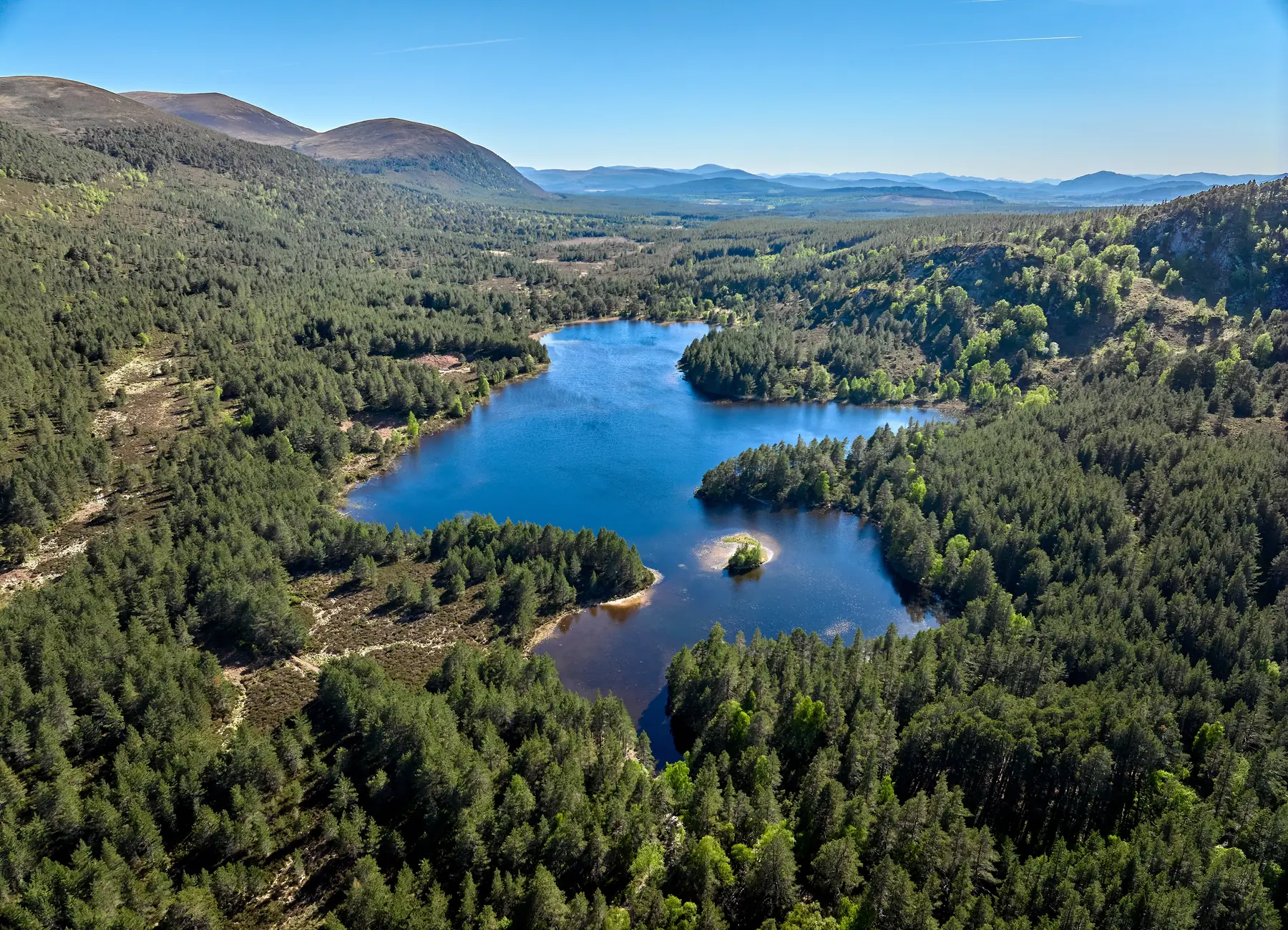
Strathspey is the best place in Britain to see wild animals, and it is not a close contest. The combination of the largest surviving fragments of Caledonian pine forest, an arctic plateau, a major river system and a great deal of protected land means that species which exist nowhere else in the country — or only just — are within twenty minutes of Aviemore’s main street.
This guide covers what lives here, where to look for it, when to go, and which of it you can see for nothing.
Britain’s only free-ranging reindeer herd lives on the Cairngorm slopes above Glenmore, eight kilometres from Aviemore. The animals were reintroduced in the 1950s and now graze the open hill year-round, tame enough to approach and be hand-fed.
The Cairngorm Reindeer Centre at Glenmore runs guided hill trips out to the herd: you walk up onto the slopes, the reindeer come to meet you, and you feed them from your hand. It involves a short uphill walk over rough, often wet ground, and it is the single most memorable thing most visitors do in Strathspey. There is also a paddock at the centre for anyone who cannot manage the hill. Book ahead — summer trips fill.
Because the herd roams free, walkers on the ski road paths and the Ryvoan track sometimes meet reindeer without paying for anything, which is a pleasant kind of luck.
Loch Garten in Abernethy Forest, about fifteen kilometres north-east, is the most famous osprey site in Britain. Ospreys returned to breed in Scotland here in the 1950s after being extinct in the country, and the RSPB’s nest protection operation at Loch Garten became one of the founding stories of modern British conservation. There is a nature centre with cameras on the nest, and the birds are present from roughly April to August.
Ospreys also fish elsewhere in the valley — Loch Insh, Loch Morlich and the Spey itself all see them — so a patient hour by any large body of water in summer is worth spending.
Two species make British birdwatchers travel to Strathspey specifically.
The crested tit lives in the old pinewoods and is found in the UK only in this corner of Scotland. Rothiemurchus, Glenmore, Abernethy and Loch Garten are the reliable places, and winter is easier than summer because the birds come to feeders.
The Scottish crossbill is Britain’s only endemic bird species — it occurs nowhere else on earth — and it feeds on pine cones in these same forests. Telling it from the common and parrot crossbills is genuinely difficult, which is part of its charm.
Add capercaillie, the giant forest grouse now clinging on in Strathspey and a few other places, ptarmigan on the high plateau, snow bunting and dotterel on the summits in summer, and golden eagles over the glens, and the area’s reputation makes sense.
Capercaillie deserve a word. The population is critically low, the birds are extremely sensitive to disturbance during the spring lek, and organised viewing is tightly controlled for good reason. Do not go looking for them independently in spring; the RSPB runs supervised viewing at Loch Garten in season.
Red squirrels are common in Rothiemurchus, Glenmore and Abernethy, and this is one of the easiest places in Britain to see them — the Glenmore visitor centre feeders are close to guaranteed.
Red deer are everywhere on the open hill and come down into the woods and the roadside fields in hard weather. The autumn rut, in late September and October, is one of the great British wildlife spectacles and can be heard from the forest tracks.
Roe deer are in the woodland year-round.
Mountain hares live on the plateau and turn white in winter, which makes them easier to see against bare ground and impossible against snow.
Pine martens, badgers, otters on the Spey and wildcats — the last of these functionally lost in the wild — complete the list. Several Aviemore operators run evening wildlife safaris with hides for the nocturnal species, which is the realistic way to see pine martens.
Thirteen kilometres south at Kincraig, the Royal Zoological Society of Scotland’s Highland park is a serious conservation operation rather than a roadside zoo. A drive-through reserve holds bison, red deer, Przewalski’s horses and other large herbivores, and the walk-round section covers polar bears, snow monkeys, wolves, Amur tigers and Scottish wildcats — the park runs the breeding programme that represents the species’ best remaining chance.
It works for families, it works in rain, and it is the only way most visitors will see a wildcat.
The wildlife exists because the habitat does. Rothiemurchus, Glenmore and Abernethy together hold the largest remaining tracts of the Caledonian pine forest that once covered much of the Highlands — open-grown Scots pine, juniper and blaeberry, with dead wood left standing and a structure that looks nothing like a plantation. Abernethy, run by the RSPB, is the largest single block.
Walking any of it is free. Loch an Eilein, Loch Garten, the Ryvoan Pass and the trails from the Glenmore visitor centre are the standard routes, and all four are good for wildlife precisely because they are quiet.
Spring brings the ospreys back in April and the capercaillie lek, and the pinewoods fill with birdsong before the visitors arrive.
Summer is best for ospreys on the nest, dotterel and snow bunting on the tops, and long light for evening watching. It is also midge season in the woods.
Autumn is the deer rut, the best month for photography, and the point at which the plateau starts to look arctic again.
Winter is the easiest time for crested tits and crossbills at feeders, mountain hares in white, and red deer down low. Days are short but the light is extraordinary.
Scotland’s access rights are generous and come with obligations. Keep dogs on leads near livestock and ground-nesting birds between April and July, stay on paths in the capercaillie forests during the spring, do not approach nests, and give the reindeer the same respect you would give any large animal on the open hill. The Cairngorms are a working landscape as well as a national park.
Guided trips. Several operators in and around Aviemore run wildlife safaris, birdwatching days and hide sessions, and a local guide will find you in one evening what would take a week alone.
Binoculars matter more here than a camera.
Getting there. The reindeer centre and Glenmore are reachable on the Stagecoach service up the ski road from outside Aviemore station. Loch Garten and the wildlife park need a car or a tour.
Free options are extensive — see our free things to do guide.
Start early — most mammals and many birds are active at dawn and settle down by mid-morning. Drive or take the bus to Glenmore for the red squirrel feeders at the visitor centre and a walk up the Ryvoan track, where crested tits and crossbills are possible in the pines. Take the mid-morning reindeer hill trip if you have booked one.
In the middle of the day, when wildlife watching is at its worst, do something else: the Loch Morlich shore, or lunch at the visitor centre. Then move to Loch Garten in the afternoon for the ospreys and the Abernethy pinewood, and finish at dusk on a forest track or by the Spey, when the deer come out and the pine martens start moving.
That single day covers three of the four habitats that make Strathspey exceptional — pinewood, loch and river — and the fourth, the arctic plateau, is a separate expedition on a clear day.
At the Cairngorm Reindeer Centre in Glenmore, which runs guided hill trips to the free-ranging herd. Book ahead in summer.
Roughly April to August, with the nest cameras running at the RSPB centre through the breeding season.
Yes, and they are easy to see — Glenmore, Rothiemurchus and Abernethy all have them, and the visitor centre feeders are the reliable spot.
Realistically, no. The Highland Wildlife Park at Kincraig is where you will see them.
May for birds and long light; late September and October for the deer rut.