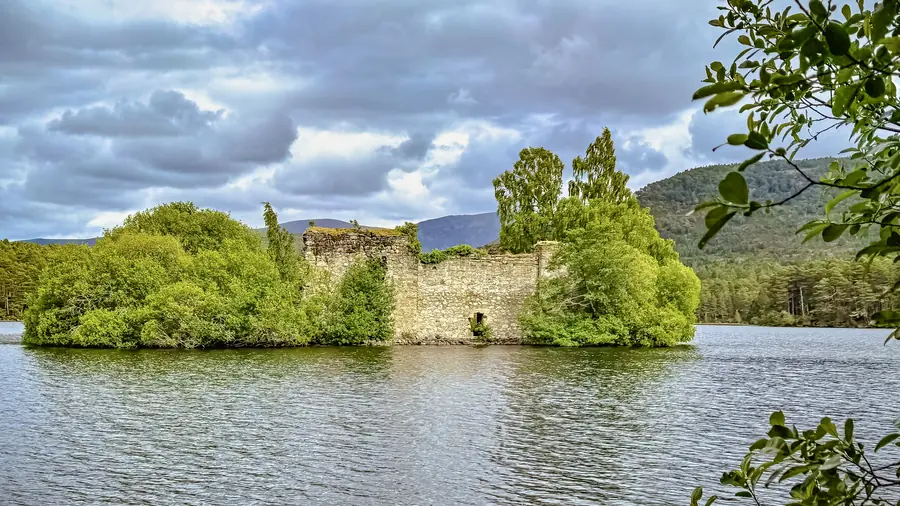
Loch an Eilein is the loch of the island, and it is the walk people mean when they say they have done Aviemore. It sits about five kilometres south of the town in the Rothiemurchus pinewood, inside Cairngorms National Park: a small irregular freshwater loch, old Scots pine around it, and a ruined castle on an islet a few metres off the shore. The plateau stands up behind. On a still morning the castle repeats itself in the water, which is why the car park fills.
The circuit is almost level, on a good forest track, and it takes about an hour at a brisk pace or ninety minutes at a stroll. It is on a working estate, with a charged car park, and the castle is not a ruin you go inside.
Strathspey is full of water. Loch Morlich has the beach. Loch Garten has the famous osprey centre. Loch Insh has the watersports. Loch an Eilein has the picture, and the picture is not a cheat: the combination of island, pine and a walk you can do in ordinary shoes is unusual even here.
It is also close. Five kilometres from Aviemore is a cycle, a walk through the estate, or a short drive down the B970 and a single-track road. You can leave after breakfast and be back in town for lunch. That convenience is why it is busy, and why going early is the whole of the tactic.
The attraction page is the facts. This is the visit.
The ruin on the island is late medieval, probably fourteenth or fifteenth century, associated with the Comyns and later with the Grants of Rothiemurchus, who still own the estate. It sits perhaps twenty metres offshore. Local tradition holds that a causeway once ran out to it, now under the raised water, and that in very dry years it has been walked. Do not plan a visit around that story.
You cannot land on the island. It is a nesting site. Access is not permitted, and there is nothing to be gained by looking for a boat. The castle is a view, from a dozen angles as you walk. The 1690 tale — the widow of the laird holding the place against Jacobites coming back from Cromdale — is the one you will be told. It may be true. It is certainly repeated.
Stand at the north end first, near the car park, if you want the classic reflection. Then walk. The building changes as you go. It is small, broken, and better for not being climbed on.
Rothiemurchus’s own walking map gives the Loch an Eilein Trail from the loch car park as 5 km, about 1 to 1.5 hours. That matches what you will do. The track runs either way around the water, pine on one side, loch on the other, with some rooty and stony sections and almost no climbing.
It is not a surfaced accessible path. A robust pushchair manages most of it; a wheelchair does not, not honestly. In winter the shaded stretches ice. After rain the sandy bits drain quickly, which is why this walk stays usable when open ground is a mess — see Aviemore in the rain.
Toilets, a small visitor point and a kiosk sit by the car park. There is a shingle shore near that end if someone in the party has had enough walking and wants to throw stones. The rest of the circuit is quieter, and the southern end, where the pines stand in the water, is the bit the crowd thins for.
Keep dogs under close control. Ground-nesting birds, red squirrels, and stock on a working estate are all reasons. The Scottish Outdoor Access Code is the rule, not a vibe.
At the southern end a second, smaller loch, Loch Gamhna, can be added as a loop. That stretches the walk to around six kilometres. It is still level, still in the trees, and it is the usual way to make a short morning into a proper half-day without committing to the Lairig Ghru.
From the Rothiemurchus Centre and the farm shop at Inverdruie, rather than from the loch car park, the estate map gives a longer trail of about 11 km, two to three hours. That is the walk if you have left the car in town, or at the centre, and want the loch as a turning point rather than a drop-off. Our walks guide places it among the other Rothiemurchus routes.
Do not confuse either circuit with a mountain. You are in the forest. The plateau you can see is a different day, with different kit.
Ospreys and Loch an Eilein are an old pairing. The castle was a famous nest site in the nineteenth century, robbed repeatedly by collectors, and the Grants of Rothiemurchus were among the landowners who tried to protect the birds when almost nobody else did. The island is still treated as a nesting site. Birds fish the loch in season — roughly April to August, the Speyside osprey window — and they also fish elsewhere in the estate. Give them room. A long lens from the shore is the visit; a closer look is not.
The pinewood around the water holds the species that make this corner of the national park famous: red squirrels, crested tits, Scottish crossbills, and, somewhere in the older stands, capercaillie that you should not go looking for. Feeders near the car park are the easy squirrel. Our wildlife guide covers the rest of Strathspey; this loch is the one you can do without a hide booking.
Goldeneye breed on the water. Dragonflies work the margins in summer. In October the birch goes gold and the deer start roaring on the hill. That is the month to walk it if you can move a date — see when to visit.
The car park at the loch is a Rothiemurchus charge. So are the parks at the centre. They are not Highland Council, and they are not free. The live ticket — a day payment, a weekly explorer, a Friends membership — sits on the estate membership page. Pay at the booth or the machine in front of you. A figure remembered from 2023 is how people argue with the attendant.
The park is small. On a July Saturday it is full before ten. There is no overflow on the access road that is worth the argument, and the road is single-track. Arrive early, or do not bring the car.
The walk itself is free. Scottish access rights cover the tracks. You are paying for the gravel, not for permission to look at the castle. Our parking article is the wider Aviemore version of the same advice: do not hunt this park for a High Street errand.
This is the better arrival.
From Aviemore, Inverdruie is about two kilometres on the B970, with a pavement most of the way. The Rothiemurchus Centre is there: farm shop, café, toilets, the start of the estate tracks. From the centre to the loch is another few kilometres on forest roads. The whole thing from town is about five kilometres, an hour and a bit on foot, much less on a bike. Hire is in Aviemore.
The Stagecoach 30 from the station runs to Coylumbridge, which is on the way, not to the loch car park. Check Traveline Scotland if you want the bus; walking or cycling is the usual approach. The car-free guide is that stay in full.
Winter access is a different calculation. The loch road is not always gritted. Ice under the pines is real. Contact the estate if you are unsure whether the park is open; do not assume a January Saturday matches a June one.
People swim. The water is clear, peaty-gold, shallow at the edges and very cold. There is a shingle entry near the car park. Cold-water shock is the hazard, not a current. Stay off the island, especially in the osprey months, and do not let a dog become a wildlife incident.
Midges from May to September, in still weather, near the water, at dawn and dusk. Repellent, a breeze, or a midday walk. They are not a reason to skip the circuit. They are a reason not to picnic at eight in the evening in August.
Ticks in the long grass. Forestry and stalking operations on a working estate — follow the signs. Fires are not a loch activity.
Early morning for the reflection and a space. October for the colour. A weekday in May or September if you want the pines without the Saturday. Winter, after snow, is the quiet version, with short light and ice in the shade.
Take lunch if you are adding Gamhna. The kiosk is a kiosk, not a restaurant; the proper café is back at the centre. There is nothing on the far side of the loch.
Loch an Eilein is a small walk in a large park, and it is the right first walk from Aviemore. Do it on the level, look at the castle from the shore, and leave the plateau for a day with a forecast.