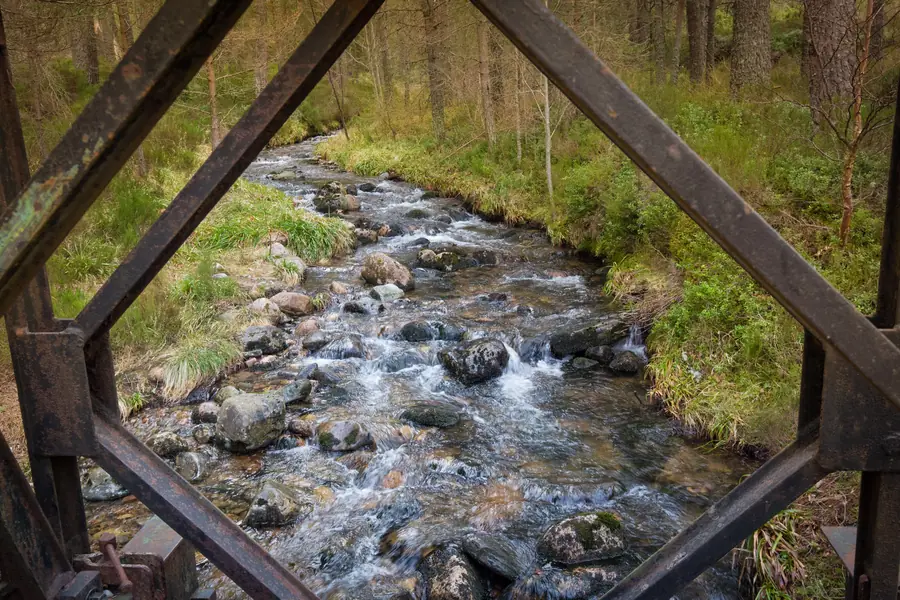
Rothiemurchus is the piece of the Cairngorms you reach before you have left Aviemore. The estate starts about two kilometres south-east of the town, at Inverdruie, and runs from the Spey up into the pines and, beyond them, toward Braeriach. It is privately owned, still in the Grant family after centuries, and it is a working Highland estate rather than a park: farming, forestry, deer, fishing and a substantial visitor operation on the same ground.
Most visitors meet it as a car park, a farm shop and a loch. It is larger than that, and it is not Glenmore Forest Park, which is Forestry and Land Scotland, further up the ski road, with a beach. Mixing the two is the Aviemore error that costs a morning.
Rothiemurchus covers more than 7,000 hectares, from river to high ground, entirely inside Cairngorms National Park. A large share of it is designated for conservation. The visitor-facing strip is the lower forest: the centre at Inverdruie, the tracks to Loch an Eilein, the approach to the Lairig Ghru from Coylumbridge, and the activity bases along the B970.
Scottish access rights apply. You can walk and cycle the tracks without buying a ticket. You cannot treat the place as an unmanned country park. Stalking, forestry and livestock all happen. Signs go up for a reason. Dogs under close control is not a suggestion next to ground-nesting birds and cattle.
The estate’s own site, rothiemurchus.net, is the live list of what is running. Activities book out in summer. A visitor in July 2026 who booked two months ahead still found places limited. That is the pattern.
This is the reason to come, and it is easy to miss if you only drive to the loch.
Rothiemurchus holds one of the largest surviving fragments of Caledonian pine forest — open-grown Scots pine, juniper and blaeberry, dead wood left standing, a structure that looks nothing like a plantation. It supports species that live nowhere else in Britain, or almost nowhere: capercaillie, Scottish crossbill, crested tit, red squirrel, pine marten, osprey on the lochs.
The tracks are extensive, sandy and drain quickly. Ordinary shoes, most of the year. That is rare in the Highlands, and it is why a wet Aviemore day is still a Rothiemurchus day — see Aviemore in the rain. Midges from May to September in still weather are the summer tax. Ticks in the grass are the other one.
Walk it slowly. The wildlife is the forest, not a viewing hide, and a quiet hour on a side track will do more than a lunchtime lap of the famous loch. Our wildlife guide is the species list; the estate is where a lot of it actually lives.
The estate’s famous corner sits about five kilometres from town: a pine-ringed loch with a ruined castle on an island you cannot land on. The circuit from the loch car park is about five kilometres, level, an hour to ninety minutes. It has its own piece on this site — Loch an Eilein — because it is the walk people plan a morning around.
It is not the whole estate. Treating Rothiemurchus as “the castle loch” is how you miss the Lairig Ghru approach, the farm, and the quieter tracks that run toward Glenmore. Do the loch. Then do something else on the same ground.
The Rothiemurchus Centre is two kilometres from Aviemore on the Loch an Eilein road, and it is the hub: farm shop, café, toilets, a booking desk, and parking that is charged. It is the natural start for a walking day and the natural finish. The café does proper food; the shop is the best provisions in the area if you are self-catering. Our eating guide puts it in the town’s food map.
From here you book, or at least start, a lot of the estate’s paid offer: quad biking through the forest (the long-running treks are a partnership on the estate, not a council activity), clay shooting, fishing, Highland cattle sessions, off-road driving, ranger walks. Hours and prices sit with the operator. Do not copy a figure from last year.
Inverdruie itself is a hamlet, not a second town. There is a pavement from Aviemore most of the way. You do not need a car to reach the centre. You may want one for the loch if walking five kilometres each way is not the day you are having.
TreeZone sits in the pines on the estate, a high-ropes and zip-line course run by IYE, not by Rothiemurchus. Book on the IYE site. Their hours, age limits and prices are theirs. The wooden hut on the B970 is easy to spot; the parking is the estate’s, which means it is charged on the same membership and ticket rules as the rest of the centre.
This distinction matters because visitor reviews mash the brands together. A ropes-course morning is not an estate ranger walk. A quad trek is not TreeZone. If you have children who want both, they are two bookings, two times, and possibly two parks. Our family guide is the rest of that calculation.
Glenmore Forest Park is the next forest east, eight kilometres up the ski road, managed by Forestry and Land Scotland. It has Loch Morlich and the sandy beach, the Glenmore visitor centre, the reindeer centre, the waymarked trails to the Green Loch and Meall a’ Bhuachaille, and Highland Council parking with an overnight ban in the FLS parks.
Rothiemurchus is the privately owned forest on Aviemore’s doorstep. Glenmore is the national forest park under the mountain. Tracks connect them — the Old Logging Way is the traffic-free line from town through Rothiemurchus to Glenmore — but the car parks, the cafés and the rules do not. Pay the estate at Inverdruie or the loch; pay the council at Morlich. FLS tickets are not valid in the council-run Glenmore parks, and Rothiemurchus tickets are not valid there either.
If you want a beach, go to Glenmore. If you want the island castle, stay on Rothiemurchus. If you want both, park once and use the Logging Way, or take the bus. Our parking article is blunt about not hunting the estate for a town errand.
The walking from Rothiemurchus divides cleanly.
Easy and level: Loch an Eilein, the forest network from the centre, the tracks toward Coylumbridge. Ordinary shoes. Pushchair-tolerant in places, not as a promise.
A half-day with a view of the pass: the Lairig Ghru approach from Coylumbridge to the Cairngorm Club footbridge and back, around twelve kilometres on easy ground, the plateau rearing up ahead. The full Lairig Ghru is a serious expedition to Deeside. The approach is not.
On a bike: the same tracks, plus the Old Logging Way toward Glenmore. Hire is in Aviemore. The estate publishes route leaflets; buy one at the shop if you want the money to stay in the forest.
The walks around Aviemore article is the wider map, including Craigellachie in town and the Glenmore hills. Rothiemurchus is the trailhead you can walk to from the station.
Parking at the centre and at Loch an Eilein is charged. It is how the estate asks visitors to contribute to looking after a forest that 390,000 people a year walk through. The current day ticket, explorer and Friends options are on the membership page. They move. Pay what the booth or the QR code shows.
Walking or cycling out from Aviemore avoids it, which is the honest free version, and it is practical: two kilometres to the centre, five to the loch. The Stagecoach 30 stops at Coylumbridge, not at the loch. See Aviemore without a car.
The loch park fills. The centre parks fill on a fine Saturday. There is no useful overflow on the single-track road. Early, or no car.
Rothiemurchus is easy to consume as a visitor product — café, loch, activity, shop — and it is worth remembering what the product sits on. People live here. Deer are managed. Trees are felled and replanted. The Grants have been on this ground since the sixteenth century, which is not a marketing line so much as the reason the pinewood still exists in this shape.
Follow the paths that are maintained. Leave the capercaillie woods alone in spring. Shut gates. Do not light fires. The access legislation that lets you walk from the town to the mouth of the Lairig Ghru is the same legislation that asks you not to treat a working estate as a theme park.
Do the loch. Buy something in the shop. Then take a track with no sign on it, as far as the time you have, and you will have seen the estate rather than the postcard.